The Sweeney Prompt
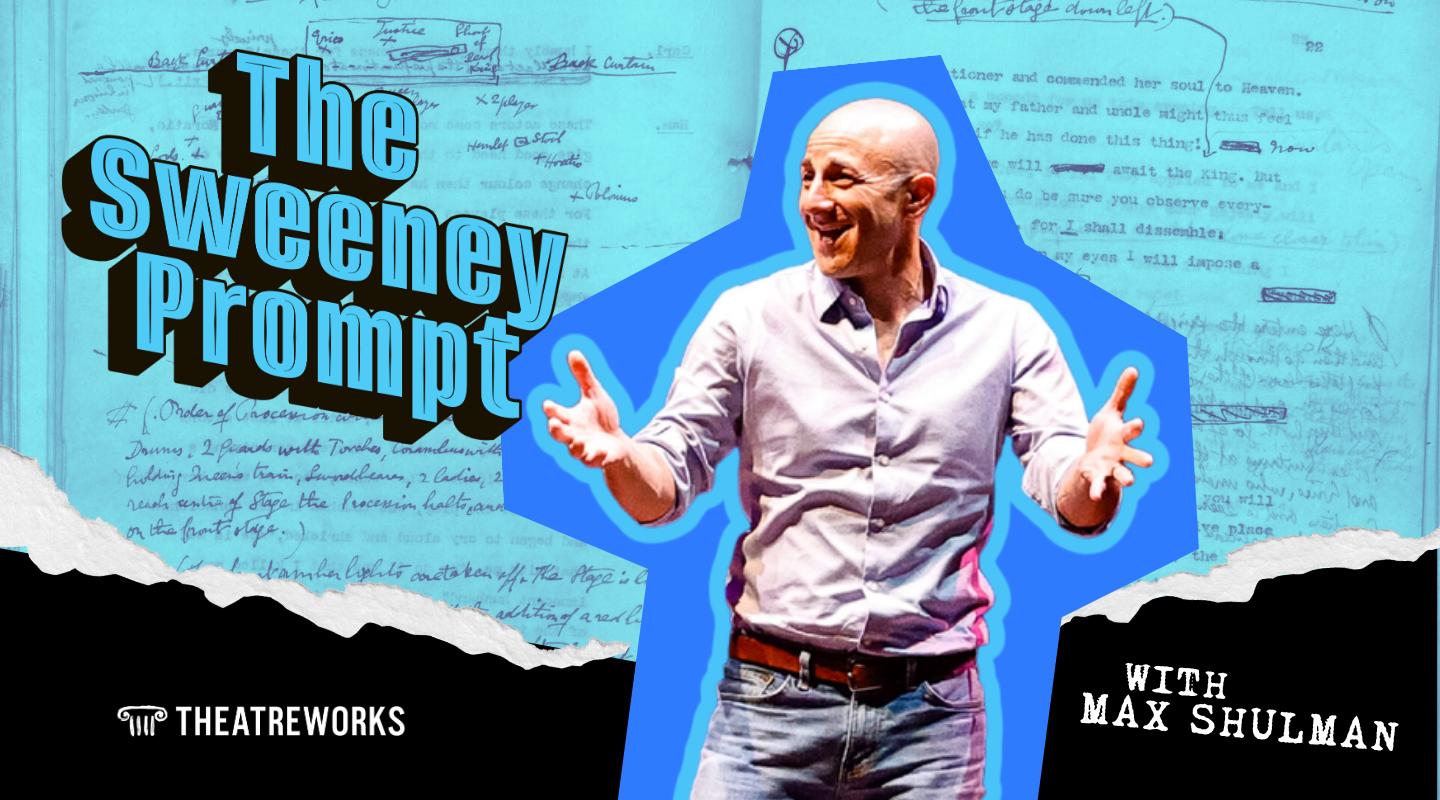
The Cue List for Sweeney Todd: The Demon Barber of Fleet Street
- Music and Lyrics by Stephen Sondheim
- Book by Hugh Wheeler
- Broadway productions: 1979, 1989, 2005, 2023
- Awards: Tony for Best Musical, Book, and Score Set – 1840s,
- London Source: The String of Pearls, 1846 “Penny Dreadful” and The String of Pearls, 1975 play by Christopher Bond
Cast and Crew:
- Director – Michael Lluberes
- Music Director – Christy Vest
- Set Designer – Eli Sherlock
- Lighting Designer – Kate Bashore
- Costume Designer – Janice Lacek
- Props Coordinator – Zach Engleman
- Cast: Sweeney Todd – Shabazz Green*
- Mrs. Lovett – Jennifer DeDominici*
- Anthony Hope – Luke Nelson
- Johanna Barker – Donna Bella Litton
- Tobias Ragg – Pluto Boll
- Judge Turpin – Jonathan Hays
- Beadle Bamford – Alejandro Gutierrez*
- Beggar Woman – Rebecca Myers*
- Adolfo Pirelli – Sam Fairley
- Jonas Fogg – Shanae Adams
(*denotes a member of Actor’s Equity)
Sweeney Todd from Low to High and Back
By Max Shulman, Artistic Director | Theatreworks
In 1979, a forty-nine-year-old Stephen Sondheim wrote a musical about a terrifying, vengeful barber who uses his victims as pie filings. It’s an admittedly bizarre scenario with a delightfully strange source text. Sondheim pulled the character and story from British “Penny Dreadfuls,” which were popular nineteenth century publications that specialized in tales of horror. These cheap, serialized booklets were popular with working-class youth. There were stories of vampires, highwaymen, and one of them followed the morbid tale of “The Demon Barber of Fleet Street,” Sweeney Todd himself. Todd featured as a character in a series of the rags, accompanied by haunting illustrations of his lurid deeds.
In the forty-seven years since its Broadway debut with actors Len Cariou and Angela Lansbury, Sweeney Todd has been revived on Broadway three times. The original production, directed by Harold Prince, saw Sweeney as the victim of the industrial revolution, pressed to violence by a corrupt social hierarchy. Angela Lansbury’s “Mrs. Lovett” was a proletarian, gleefully grinding bones to get ahead. The production was a huge spectacle at full blare, embodying Sondheim’s gigantic score with an orchestra of 26 instruments. In 1989 and then 2005, (the latter with Michael Cerveris and Patti LuPone), it was an intimate haunted house, stripped down to its emotional skeleton with a small cast playing the instruments themselves. In 2023, actor Josh Groban brought his powerful operatics to an emotionally haunting and naturalistic production directed by Thomas Kail. Producing Sweeney is always a bold endeavor. The music is so precise and epic, there is no hiding. But, its stylistic and narrative oddities make way for these myriad interpretations – it’s Wagnerian in emotional range, reminiscent of Edgar Allen Poe in subject, with flashes of English music-hall comedy. It invites theatricalization and innovation. Theatreworks’s production, directed by Michael Lluberes, uses a 10-person cast, inventive set design, and a small, string-heavy quartet to create an immersive intimacy. It focuses on the intricacies of the music and highlights the complex emotional arcs beneath the seismic score. As always at Theatreworks, we want to put you right in the action.
Reckoned one of the greatest works of American musical theatre, part of Sondheim’s accomplishment is the blending of low and high culture, the grotesque and the sublime. He places the heights of tragic emotion and operatic expression in the sewers of London, a bit like Dickens’s Oliver Twist. He alters the original Sweeney of the Penny Dreadfuls from a mad barber of no moral compunction to a wronged father and husband, shifting the clear moral lines of cheap melodrama into a murkier revenge tragedy of an imperfect hero, aligning it with other great revenge stories such as Hamlet. The world of crooks and creeps reminds me of Bertolt Brecht’s Three-Penny Opera about the murderer Mack-the-Knife (there, popular jazz becomes a vehicle for social critique). We quake at the idea of meeting Mack (like Sweeney), but we love his dirty deeds. It’s another play that humanizes and legitimizes an underbelly of corrupted criminals as a way to question contemporary mores.
Sondheim integrates other highs into his lows: Greek myths of Cronos, Thyestes, and Tereus share in Sweeney’s cannibalism. Shakespeare cooks up similar pies in Titus Andronicus (the same happens in Game of Thrones). But it is only Sondheim that makes this trope so typical of grand mythology into something so delightful as he does in the song “A Little Priest.” In it, Mrs. Lovett and Sweeney drive each other to hysterics imagining the taste of different professions. Here, a grotesque idea mutates from revulsion into a strange empowerment. When Sweeney declares in his song “Epiphany” that the world is so corrupt that everyone deserves death, the maniacal notion comes across as a kind of righteous triumph. And we, as audience, are caught up in what the philosopher Immanuel Kant would call the “sublime” – a feeling of moral superiority so strong that it quells any fear of death. Like Nietzsche’s “Übermensch,” Sweeney is going to make his own morality. Somehow, Sondheim crafts these torrential experiences all from a story pulled from the pages of an adolescent comic book.
Like a great tragic play of old, Sondheim’s Sweeney Todd creates a situation so tangled that there is no safe way out of it. It can’t simply end with the good rewarded and the bad punished. Anyone who comes into Sweeney or the Judge’s orbit gets dragged down into corruption with them. Director Lluberes pointed out that the characters in Sweeney are all cursed with obsession. They are like crystalized versions of specific impulses. Sweeney is wrath, Lovett is covetousness, the Beggar Woman is sorrow, the Judge is pride (and lust too). They are so driven by their obsessions that they twist any decent impulse to an extreme that devolves into immorality. It may be that in a corrupted world, even heroism is corrupt. It’s a valid consideration in our contemporary society. What does justice actually mean? Can we properly channel moral impulses? Or do we get carried away and lose the humanity we hope to preserve by acting on our principles? In essence, with Sweeney Todd, we come for the score, the story, and the performances, we laugh and cry, but we can’t ever forget what’s in those pies.
Links
- The original Penny Dreadful of Sweeney Todd: The String of Pearls (1850)
- Sondheim on Sweeney Todd
- 60 Minutes Piece on Stephen Sondheim
- Podcast: Sweeney Todd’s Victorian London
- History: The Great London “Stink” of 1858
- Daily Life in London
- Sweeney Todd, Deeper Dive into the History
The Greatest at his Greatest
By Matt Giles, General Director | Theatreworks | (Self-Proclaimed Sondheim Devotee)
I love Stephen Sondheim. I have directed and acted in productions of his musicals. I have belted along while listening to cast recordings as I drive. I own both of his autobiographical lyric collections. I love the intelligence of his lyrics, the architecture of his music, and the complexity of the characters he creates.
I do not have a favorite Sondheim musical. They are all special to me in their own way. But I will admit that Sweeney Todd is the show that made me fall in love with Sondheim. This may seem odd since nothing about the story of Sweeney Todd screams, “this should be a musical!” A Victorian revenge melodrama about a wrongfully imprisoned barber who returns to London to murder his enemies, aided by a woman who turns the bodies into meat pies. The Sound of Music it is not.
This is the genius of Sondheim. Company is a concept musical about a bachelor considering marriage. Sunday in the Park with George is a musical about a painter staring at a canvas. Assassins is a musical about people who tried (sometimes successfully) to kill American presidents. Merrily We Roll Along is about three friends looking backward at their lives…and the entire show unfolds in reverse order. And somehow, Sondheim made all of them feel like they were always meant to be musicals.
Sweeney Todd may be the best example. The score is astonishing. There are melodies that seem to belong to another century alongside music that feels startlingly modern. The lyrics are intricate without ever sacrificing substance for style. And Sondheim uses repetition, musical motifs, counterpoint and rhythm not simply to make beautiful music, but to reveal character and propel the story. By the time Sweeney and Mrs. Lovett's worlds collide with the other characters around them, the musical feels almost inevitable, as if the entire thing has been tightening a noose from the very beginning. You may ask, “doesn’t every musical do that?” To an extent. But not to this extent.
That may be why Sweeney Todd is the arguably the epitome of Sondheim’s genius. It showcases his brilliance: sophisticated music, extraordinary lyrics, moral ambiguity, dark humor, psychological complexity, and an almost ruthless understanding of theatrical storytelling. Company changed what a musical could be. Into the Woods transformed fairy tales into something darker and more human. Sunday in the Park With George explored art and creation. But Sweeney Todd somehow contains all of those impulses at once, wrapped inside one gloriously theatrical piece of melodrama.
And I think that is why it endures. Sweeney Todd is not a musical about a demon barber. It is a musical about what happens when we allow our worst desires to become our purpose. And Sondheim makes that story thrilling, funny, frightening and, ultimately, heartbreaking in the way that only he can. How lucky are we that we get to experience it?
Prologue
By Dr. Kevin Landis, Theatre & Dance Program | UCCS Visual and Performing Arts
For over 16 years, the award-winning series, Prologue, has provided insight into our shows and the greater American theatre scene. This year we have three talks planned and hope to include a couple more based on guest availability.
The most famous American critic of the last 30 years, Ben Brantley of The New York Times, will be with us September 20th to talk about the works of Stephen Sondheim, specifically Sweeney Todd and Company. For What the Constitution Means to Me we have esteemed constitutional scholar, Helen Norton, scheduled for a February 7th visit. And on the occasion of Sweat, we will host the original Broadway director and one of the co-creators, Kate Whoriskey, on April 25th to talk about the development of that now famous production.
Guest lists don't get better than that! We know that some schedule your play-viewing around Prologue. Please understand that sometimes schedules have to change, and more guests may be added. We will keep you updated throughout the season.